IMC Club
The IMC Club meets on the first Thursday of every month from 6-8 PM at ACI Jet.
IMC Club 2026-10-01
Scott couldn’t make it so John grabbed a presentation from the EAA website on VOCA and Obstacle departures. The presentation is here.
IMC Club 2026-09-03
Scott went through RNAV approaches with us. I thought it would be useful to summarize the types and provide a glossary of terms.
GPS with WAAS
LPV (Localizer Performance with Vertical Guidance) can get down to 200' and 1/2 mile visibility if there is an approach light system. Otherwise visibility is 3/4 mile. Has decision altitude.
LP (Localizer Performance) no vertical guidance. Has decision height.
LP+V The +V is purely an advisory glidepath on your instruments. It is not charted. It provides no obstacle protection. Has decision height.
GPS without WAAS
LNAV/VNAV (Lateral Navigation and Vertical Navigation) Has decision altitude.
The receiver must have baro-aiding. Garmin’s non-WAAS GNS 430, GNS 530, and G1000 should have baro-aiding if installed properly. Check the AFM supplement to be sure.
LNAV (Lateral Navigation) Has decision height.
LNAV+V
Advisory vertical guidance deviation is provided when the GNS annunciates LNAV+V or LP +V. The controlling minimums remain LNAV or LP even when advisory vertical guidance is provided. Advisory vertical guidance information displayed on the VDI in this mode is only an aid to help flight crews comply with altitude restrictions.
Links
Approaches Simplified
Approaches
AOPA
IMC Club 2026-07-02
Santa Maria Airport
Understaffed at the moment
Tower Hours are 8-5:30 Closed Wednesday and Thursday
Closed for 45 minutes for lunch
North
The tower doesn’t talk to Oakland Center so they will clear you out of LA TRACON airspace but once you enter Oakland you will probably get an amended route.
You will get a TEC Route with the appropriate altitude for your type of aircraft. There are some issues with TEC routes in their computers and they will change to Q routes on July 9.
File airways and avoid Restricted airspace. You may get direct once airborne.
The tower will pick you up on their radar at around 400'. Once they verify course and altitude they will hand you off to Santa Barbara.
Requesting a VFR climb and Special VFR
You need to use the magic words if you want them.
VFR climb was developed for mountainous areas so that GA airplanes with slow climb rates don’t have to fly miles out of the way on VFR days. You can climb to the IFR altitude with any route. Once reaching the assigned altitude the flight switched from own nav VFR to IFR.
You will not get a VFR climb if there is overlying airspace like in LA or SF.
Multiple Practice Approaches
File SBP - MQO - SBP
Line Up and Wait and crossing runways
Don’t dawdle. Start moving once you are given the clearance and read back as you move. [Make absolutely sure that you are the one who got the clearance and not an airplane with a similar callsign. JS]
Flight Following
Call before taxi and give them
Aircraft (Tail number)
Destination
Type (without equipment suffix)
Altitude
Same applies if you filed an IFR flight plan. Don’t wait until you are in the runup area or talking to the tower because they will have to coordinate with ground and it will delay you.
IMC Club 2026-06-04
We planned to have Dylan from the tower but he got tied up in a meeting with the FAA. Scott led a discussion of general IFR topics.
IMC Club 2026-05-07
For the second meeting we watched a video of a flight plan that had the pilot fly to an airport with an ILS and then ask for Special VFR to get to an airport 11 miles away. The weather had deteriorated to less than VFR at the destination airport. The discussion centered on the airspace cloud clearances required, what that actually looks like in the air, and the fact that they could have easily landed at the first airport and taken an Uber to the destination. It was also pointed out that Special VFR has been around forever and at one point, when instrument approaches required expensive ground equipment, it was useful but with a GPS approach at every airport using it as part of the flight plan is not a wise move.
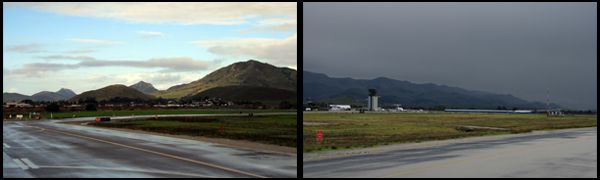
Many of the pilots have used Special VFR to get into or out of KSBP since the fog often rolls in making the field IFR but the approach end of the runway is still clear. There are also other times when the field is still IFR but it’s clear a few miles away.
7-5-1. AUTHORIZATION
SVFR operations in weather conditions less than basic VFR minima are authorized:
3. Only within the lateral boundaries of Class B, Class C, Class D, or Class E surface areas, below 10,000 feet MSL. SVFR is not authorized within Class E extension areas.
4. Only when requested by the pilot.
5. On the basis of weather conditions reported at the airport for which the surface area is designated.
[Source]
§ 91.157 Special VFR weather minimums.
(b)Special VFR operations may only be conducted—
(1) With an ATC clearance;
(2) Clear of clouds;
(3) Except for helicopters, when flight visibility is at least 1 statute mile; and
(4) Except for helicopters, between sunrise and sunset … unless— [Both pilot and aircraft are IFR current.]
IMC Club 2026-04-02
The first meeting covered the instrument scan. Participants discussed the use of the autopilot and how to react when the autopilot disengages because of turbulence. Participants were asked what topics would be good for future meetings and ForeFlight and Weather were suggested.
Noelle suggested a video series by Brian Schiff that goes into detail about the features of ForeFlight.
I’m making a playlist of my favorite ForeFlight videos and Wings Courses. These two will be at the top of my list.
This video is one of the best on the ForeFlight weather features you may not know about.
ForeFlight has a new feature, Dynamic Approach Plates, that make using approach plates much better.
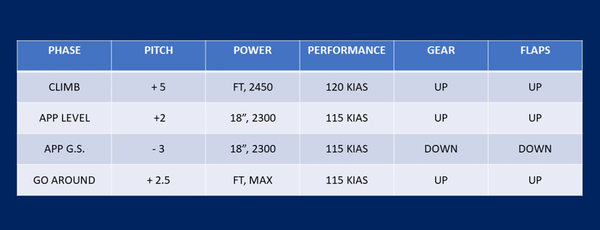
We touched on the fact that Pitch plus Power equals Performance. This is an example of the chart that should be in every IMC pilot’s checklist.